Dji Mavic 3 Pro: have we finally got the dream photography drone?
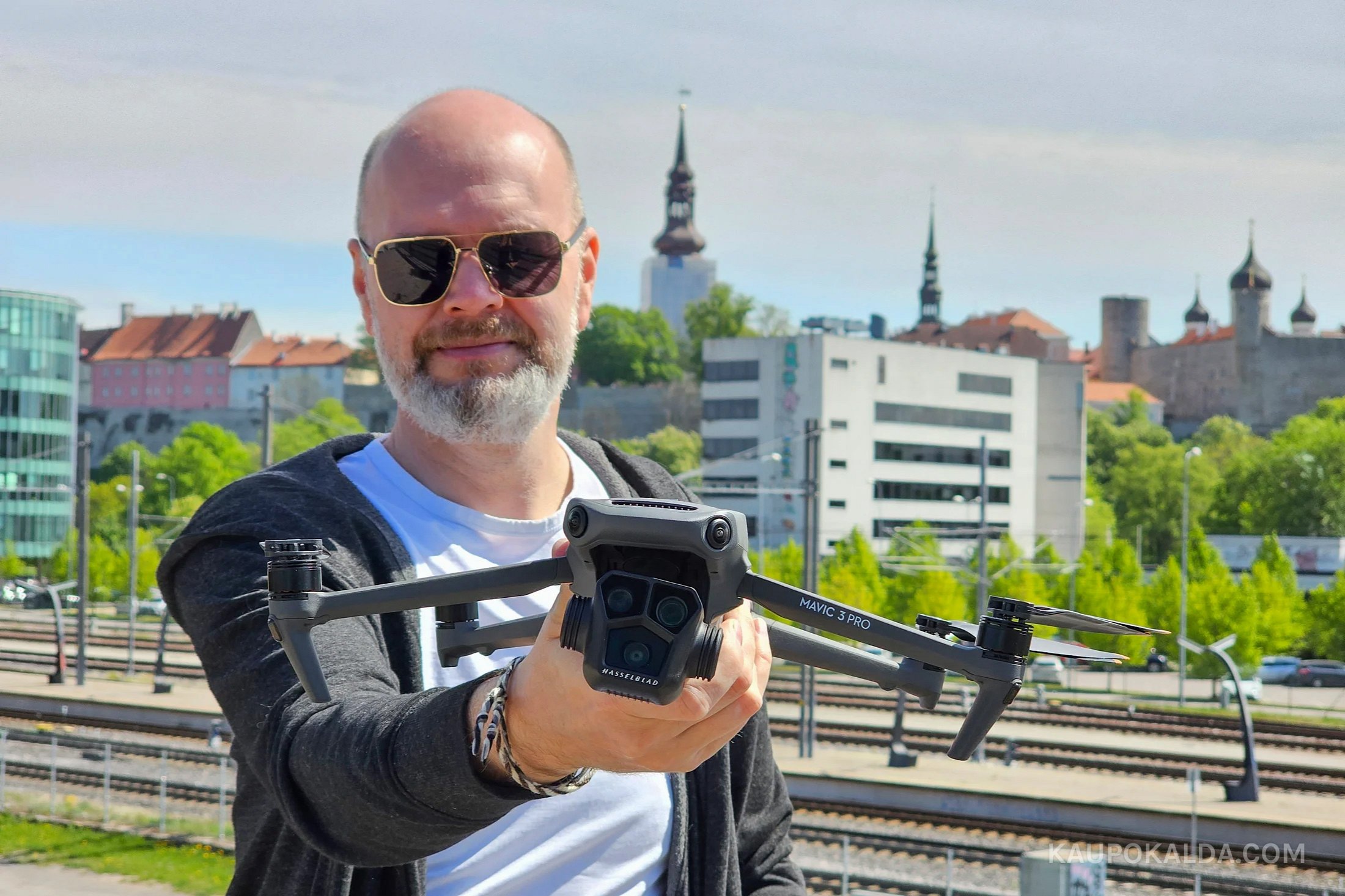
Spoiler alert - yes, we did! As a photographer, I have been involved in the world of drones for nearly ten years now and have owned various models, from small, rickety ones to large drones. During this time, there has been tremendous technical development.
One of the most noteworthy was undoubtedly the larger Dji Inspire 2, whose extensive lens selection (15, 25 and 45mm) made it a true flying photo studio. In 2021, I gave it up when the Mavic 3 came onto the market. The Mavic 3 has been a very, very good work drone for me, but I clearly missed one important difference from my Inspire 2 days - the longer lenses, which greatly expanded the creative possibilities. With the arrival of the Mavic 3 Pro, this has finally been addressed.
In this article, I won’t focus much on anything else - everything is as good as before, the batteries and flight characteristics, and there are plenty of reviews covering all of that. Let’s talk about the cameras, primarily from a photography perspective.
Comparison with others and updates
The previous model - the Mavic 3 - has an excellent Hasselblad camera with a 24mm lens, and a relatively poor 160mm camera with a soft image was added on top. It was good enough for observation, but couldn't produce high-quality creative work, and I never used it professionally. Incidentally, that model is no longer sold - now there is the Dji Mavic 3 Pro (with 3 cameras) and the Dji Mavic 3 Classic (with 1 camera).
The Mavic 3 Pro brought 2 changes at once - the telephoto is now a full 166mm and produces a considerably better image. A third lens also joined the lineup - a much more practical 70mm with a fixed f2.8 aperture. This 70mm is the Mavic 3 Pro's most unique innovation and one that expands creative possibilities with a drone. The Mavic 3 Pro's advantages over the Inspire 3 are therefore - smaller, quieter, safer, 5x cheaper, longer flight time and 3 lenses on board. From a photographer's perspective, the Inspire 3's advantage is of course its full-frame camera. But having those 3 lenses on board at all times is incredibly convenient, because you don't have to come back, land and change lenses between shots, for every angle. When there are sometimes only a few minutes of good light, there simply isn't time to change.
So now we have 3 cameras on board.

Main camera: 24mm wide angle

This is the same Hasselblad as on the previous model, with excellent image quality and dynamic range. Definitely the best camera in its class, a high-quality wide-angle camera.

News: 70mm medium telephoto

A nicely sharp image and, considering the relatively small sensor - a perfectly good camera. It seems to me that its quality is comparable to the Dji Mini 3 Pro camera, and the sensor size is similar in terms of specifications too; the lens is of course different (medium telephoto).
A very practical range, which in my work often means being able to visually compress space. If a regular wide-angle camera makes, for example, a view of the Old Town behind a building look farther away than it does to the human eye (and that doesn't exactly enhance the property's selling points), then 70mm brings it 3x closer relative to the property and is much truer to human vision. The perceived "focal length" of the human eye is somewhere in the 50-70mm range.

The 70mm is also usable in the dark. I haven't tried it in the wind yet.

It is also convenient for photographing details, or even events and other places with restricted access, while staying safely farther away or outside the restricted area. For example, Stenbock House or the Riigikogu castle, which would require applying for permission in advance.
In video, this creates a cool parallax effect, where the foreground and background move in layers relative to each other.
Like a telescope: 166mm telephoto
166mm. The drone and I were at the Circle K by Linnahall at the time:

This so-called 7x zoom is actually a rather impractical focal length for a drone. It has proved very well suited to reconnaissance in Ukraine, where it is extremely popular because the digital zoom goes all the way up to 28x.

166mm video:
The telephoto is now brighter at f3.4 and significantly (!) sharper than the previous 160mm. Quite usable in certain conditions, for example social media posts, nature observation, etc. The lens itself is quite sharp, but the colours and other aspects need more processing.
Each camera’s angles of view:

I discovered another interesting possibility - if I hover it low over the sea, I can calmly film birds going about their business without disturbing them. The surprisingly stable camera produces 4K video, although its image quality is somewhat inferior to that of its shorter siblings.
Here is an example of the zoom capability. 3x and 7x are very capable; the rest is digital zoom.
C2 marking and A2 category, exam
Unfortunately, the Mavic 3 Pro is a few dozen grams heavier, over 900g, which puts it in the C2 class (it bears the official marking) and therefore in the A2 operating category. The regular Mavic 3 is C1 and A1.
By the way, I have an article about Estonian drone rules and the drone map in general here. You can read more about the open category (A1, A2, A3, which includes drones marked C0, C1, C2 and C3) From the Transport Administration website. There is also a small tool there that lets you test which category you are flying in.
The main difference is that some additional restrictions apply and you have to take the A2 exam. Fortunately, the exam isn't difficult; it mostly covers weather knowledge and ways to fly more safely. The A2 study materials can be found From the Transport Administration website 3 chapters' worth.

Since the Mavic 3 Pro has an official C2 marking:
- You must not fly over groups of people
- You must keep 30m or 5m away from people low speed mode
- You must keep away from people, also observing the 1:1 rule, meaning altitude = distance from people. For example, when flying at a height of 50m, you must be 50m away
- The A2 exam must be completed
If you have another drone weighing between 900g and 2 kg, but it DOES NOT have an official C marking, the rules are stricter:
- 50m from people
- The A2 exam must be completed
A2 exam to complete it you must loisto submit an application from
Log in > Applications > Start a new application > Application for a remote pilot A2 certificate of competency
You'll then receive an email to register for the exam. Choose a time, and the exam takes place at the ARK Mustamäe service office at Heli 6. Go in through the door and the lady at the information desk will tell you where to go. Bring your ID card.
The exam has 30 questions (topics those very same ones three chapters of A2 study materials), 45 minutes, multiple-choice answers on a tablet. It took me about 10 minutes and I scored 100%, it wasn't difficult. Just read and listen through the A2 materials a couple of times.
For example, there are questions about turbulence (distinguish between mechanical turbulence (forests, buildings) and thermal turbulence (air movement caused by the sun's heat)), a couple of questions about cold, batteries and W and Wh, the 1:1 rule (if you fly at a height of 20m, you must be 20m away from a person), the effects of wind, propellers, air density, etc.
In summary
The Dji Mavic 3 Pro is the drone I have been waiting for as a photographer for years. It is small, quiet, relatively safe, reasonably priced, has a long-lasting battery and a unique 3-camera system right on board.
The new 70mm is definitely something I will use actively in my creative work. The first commissions have already received very positive feedback in this respect. Of course, there is still room for improvement, but there always is, and future models will surely bring it. We live in very exciting times!
Photos: Kaupo Kalda and dji.com
PS. When I'm asked where I recommend buying drones, the answer is always the same - from the importer droon.ee, who also provides you with strong customer support and maintenance.

70mm example